It’s time for a little update, not much, but I am no longer new to blogging. I have been at it a few years. Not that I have gained any particular stature. I simply can’t claim to be new at it. I still write as part of my profession, but blogging is more interesting. Blogging is my way of sharpening ideas and fleshing them out. It’s a journey, and I know I don’t always “get it right”, but I take it seriously.
I have been on a journey for truth since I emerged from the haze and confusion of adolescence, much of it self-induced. Stepping out of that myopic existence I began to get an inkling that a world of truth lay in front of me to encounter, and so I set off. I didn’t realize, then, how much faith is required to seek truth.
The contrast between the ministries of Elijah and Elisha provides insight that carries into the coming of the Messiah, the ministry of Jesus, and the New Covenant. The contrast between Elijah and Elisha is a contrast between the Old Covenant and the New Covenant. It is a contrast between an emphasis on the judgment of God and an emphasis on the grace of God and salvation.
In my ignorance, Elijah previously stood out more to me than Elisha, even though Elisha famously asked for and received a double portion of the spirit Elijah had. The spirit of Elijah passes to Elisha as seen in the miracles each of them performs. Scholars often highlight the fourteen miracles performed by Elisha versus the seven miracles performed by Elijah as an example of the double portion, but the differences between Elijah and Elisha go much deeper than that.
The character of the miracles is different. This is something I might not have noticed but for a focus on the details in the story of Elijah over the last few years. Those details led me to see some lessons from the story of Elijah that do not stand out at first blush.
Elijah was an oppositional prophet. He was the antagonist to Ahab and Jezebel. He challenged the prophets of Baal and smoked them in a fiery display of God’s power over the impotent idol (Baal) that Ahab and Jezebel worshipped.
Elijah had all the prophets of Baal slaughtered, but Jezebel was not impressed. She called for Elijah’s head, and he fled in fear. He sulked in self-absorbed pity. He complained to God that he was the only one who was faithful, and he seemed to come close to finding fault even with God for the anti-climactic outcome.
When God tried to show Elijah that God was not in great displays of power like wind, fire, and earthquake, Elijah seemed incapable or unwilling to acknowledge what God was saying. Twice God asked why Elijah ran away to Mount Sinai. Twice Elijah gave God the exact same answer.
Elijah protested to God that he had been zealous, and he insisted that he, alone, was faithful to God in all of Israel…. But clearly, he was not alone. Multiple times the text tells us that Obadiah was faithful; he saved 100 prophets from Jezebel’s decree of capital punishment; and God found 7000 people left who had not bowed to Baal.
Elijah seemed not just disappointed, but upset (with God?) that judgment had not rained down on Ahab and Jezebel and all of Israel. It wasn’t that judgment didn’t loom over their heads; it was that God controls the timing – not Elijah.
God told Elijah to go back and anoint Hazael king of Aram and Jehu king of Israel and to pass his mantle to Elisha. Elijah passed the mantle to Elisha but he never followed through with the other instructions God gave him.
Elijah continued in ministry even after he passed his mantle to Elisha, but he seems to take a back seat to other prophets, and he did not change his attitude. God told him to meet the messengers of the King of Israel to deliver a message. After they delivered the message to the king, the king sent them back to summon Elijah, but he smoked them by calling down fire. The king sent another envoy of messengers, and Elijah smoked them with fire also – killing 50 people at a time.
Though God told Elijah to confront the king’s messengers with his own message, the text is conspicuously silent about Elijah calling down fire on the envoys who came to summon him. The King sent a third group of messengers to summon Elijah, and this time God told him to go with them.
Now that I have spent some time meditating on the stories of the two prophets, Elijah stands out for his brashness, but Elisha stands out as the prophet who is more true to who God is. He is the one whose ministry is more characteristic of God, and his ministry stands out in the way way it bridges the narrative arc of Scripture between Old Covenant and New Covenant, from a focus on Abraham’s descendants to all the nations, from the Law of Moses to the Law of grace, love and Christ.
Elisha signals the change from the old covenant to the new covenant. Elisha points the the direction that the arc and sweep of Scripture will take us. Elisha is the link in this point in the narrative to God’s ultimate plans and purposes in the world.
Elijah is a hero of the faith. When we think of people of faith and obedience to God, he would be near the top of anyone’s list. He is one of only two people to appear with Jesus on the Mount of Transfiguration.
Interestingly, though, he isn’t listed n the “hall of faith” in Hebrews 11. I don’t know why Elijah isn’t mentioned in Hebrews 11, but (perhaps) we should not be as enamored of Elijah as we might want to be. I say that with due respect to Elijah, an unquestioningly bold man of great faith.
On the Mount of Transfiguration, God the Father exalts Jesus the Son of God in the presence of Elijah and Moses. When the Father declares, “This is my beloved son, with whom I am well pleased; listen to him,” the Father echoes the words of Moses to Israel: “The LORD your God will raise up for you a prophet like me from among your brothers. You shall listen to him.” (Matthew 17:5; Deut. 18:15)
Then, Elijah and Moses disappear. Only Jesus remains.
Elijah and Moses are the champions of the old covenant. Jesus came to announce a new covenant, a better one, a covenant that dates back before Moses to Abraham, when God counted his faith as righteousness. The disappearance of Elijah and Moses on the Mount of Transfiguration is not just symbolic; Jesus introduced a new covenant, a new way of relating to God, and a new purpose for the people of God.
People have always loved power and spectacular displays of power, but we do not see God most accurately portrayed in Elijah or even Moses. Only Jesus is the exact representation of God (Hebrews 1:3), and Jesus reveals God in a way that is much more nuanced and strikingly different then the way we see God through Elijah or Moses.
Not that God is any different of course. God does not change. It’s just that our perspective of God changes when he sheds his glory and becomes man in the form of Jesus. In the stripped-down version of God in human form, we see the character of God as it is displayed on our level.
In this context I want to look again at the story of Elijah and the lesson God sought to teach him on Mount Sinai – a lesson that did not resonate with him, but which is told for our benefit. It is a lesson we should grasp as we seek to follow Jesus as he walked and as he told us to follow him.
I apologize upfront for the length of this blog post, but there is so much in the text that I want to pull out and examine. I don’t think I could do it justice in a shorter blog post. To be honest, I think a whole book could be written about this.
The primacy of faith may never have been more prominent than it is today in this post-postmodern, metamodern world. AI experts say that “hallucinations” are inevitable and unavoidable in the way AI works. Skepticism has already become the default posture of people in this social-media dominated world in which fake news is old news. It’s no longer what you trust, but who you trust. “Pick your poison, and go with it” is the metamodern response.
The advent of AI and its looming takeover may unravel the very foundation of our confidence in knowledge. If skepticism has long been the province of intellectuals in the know, it is now the common denominator of everyone who trusts only what they know from the people they trust and news outlets that feed them.
If we are not postmodern enough already, our skepticism will increasingly become more necessary than ever. In just a few years of the AI revolution, determining what content on social media is AI, not AI, or only partially AI is becoming increasingly fraught. The challenge will only get more difficult as AI gets better. Even college professors have difficulty determining student work product from AI work product
AI is only going to get better (or worse, depending on your viewpoint). The capacity of AI to churn out convincing content with great confidence (and lurking uncertainty) may overtake our ability to keep up with it. Over fifty percent of all social media content is currently produced by bots, a form of AI, and that statistic is likely to climb higher. Human productivity cannot keep up with the productivity of AI.
AI feeds on itself. Garbage in produces garbage out. AI repeats itself by design, and it will inevitably repeat the good with bad, leaving us ever attempting to discern and decipher which is which.
In a world like the one we are facing, faith becomes more important than ever. By faith, I mean trusting and having confidence in something. What we put our faith in will become more and more important.
This revelation comes as postmodernism is breaking down. That postmodernist, existentialist angst is hard to live with. We have to put our faith somewhere – and this is the meta-modern trend that we are now facing. Faith – where we put our confidence – is the question of the day.
Metamodernism has taken hold on our culture and psyche according to people who study these things. Despite the post-modern assumption that we can trust nothing, we choose to trust something in a metamodern world because the alternative is untenable and unsustainable.
Social psychologists say that we are living in a world marked by anxiety, depression, suicidal ideation, and isolation, and these problems are falling with heaviest weight on our youngest population. In a world like that, they learn they have to cling to something. They have to find something solid they can hold on to. If they don’t, everything is always falling away from them. They have nowhere to stand.
In a world like that, faith is inevitable and unavoidable. It is necessary for survival.
Perhaps we are arriving at this place too late. It certainly isn’t too soon. In fact, the place where we now stand, where it seems there is nothing solid to stand on, was foretold thousands of years ago in the Book of Ecclesiastes.
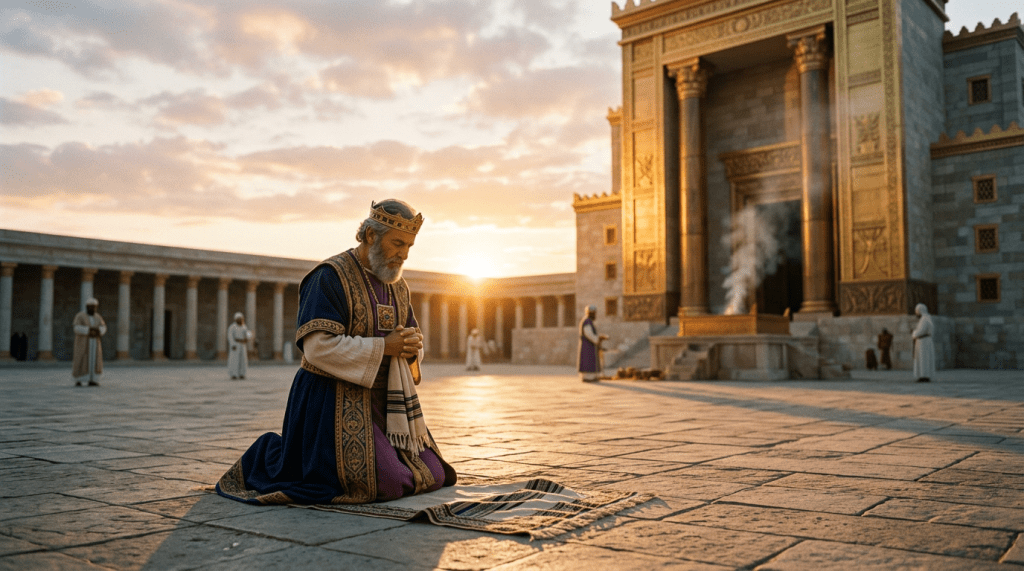
When King Solomon completed the Temple for God in Israel that David committed to build, he praised God for being true to His promise, for bringing His people out of Egypt, for choosing them to dwell among, and to have a Temple dedicated to Him in the City of David – Jerusalem. (2 Chronicles 6:1-11) He said,
“Lord God of Israel, there is no God like you in heaven or on earth – you who keep your covenant of love with your servants who continue wholeheartedly in your way.”
2 Chronicles 6:14 (NIV)
At the same time, Solomon acknowledged that not even the highest heavens can contain God – much less a temple built by human hands. (v.18) Our God is the Lord over all the earth, and He made a covenant with Abraham to bless all the nations of the earth.
Solomon petitioned God to hear the prayers of the people of Israel (vv.19-21), to remember them when they repent for failing to love their neighbors, to judge those who are guilty and vindicate the innocent are wrongfully accused, and to forgive them when they repent of their sin, to “teach them the right way to live,” and to fear the Lord and walk in obedience. (vv. 22-31) Strikingly, Solomon included foreigners in his prayers:
“As for the foreigner who does not belong to your people Israel but has come from a distant land because of your great name and your mighty hand and your outstretched arm—when they come and pray toward this temple, then hear from heaven, your dwelling place. Do whatever the foreigner asks of you, so that all the peoples of the earth may know your name and fear you, as do your own people Israel, and may know that this house I have built bears your Name.“
2 Chronicles 6:32-33
Solomon was mindful not just of the people of Israel; he was mindful of foreigners “who come from a distant land” because of God – asking God to do for them what they ask. He did this “so that all the peoples of the earth may know your name and fear you.” In doing this, Solomon remembered and honored God’s great promise to Abraham to bless all the nations through his descendants.
Let us remember and honor this promise of God today in our own land and in our own lives. God is no respecter of persons – or nations – who do not align themselves with and live out the promises and global purposes of God. Just as God promised judgment and and hardship for the ancient nation of Israel if they failed to live out their own covenant promises to God, He is and will be true to that promise for His people today – wherever they are scattered around the earth.
We are blessed when we are not just hearers of His word, but only if we are doers of His word. (James 1:22-25) God does not describe exactly how we do that. We need the guidance of His Holy Spirit to discern how to live this out in the 21st Century where we live. If we want to blessed by God and faithful to Him, however, we cannot ignore these things.
I pray that we will lean into God’s great covenant promise to all the nations of the world to live out His purposes and intentions to attract all people to Himself. May we learn to follow the prompting of the Holy Spirit in our own lives acknowledge and honor God in this way in our daily lives, individually and corporately, as the people of God.
I am reminded often that God’s faithfulness is new every morning, and God’s faithfulness is the subject of my inspiration today. I am going to start my meditation with the Euthyphro dilemma – a strange place to begin, maybe, but it sets the stage for some thoughts I have on faithfulness.
The Euthyphro dilemma poses a seeming conundrum: Is God good because He determines what is good as a matter of fiat, or is God good because goodness is objectively required of God just as it is required of us? In other words, does God arbitrarily establish what is good, or is God subject to what is good?
Of course, this is a false conundrum. It assumes there are only two possibilities: that God arbitrarily establishes what is good or that God is subject to what is good.
There is at least a third possibility—that good is determined by the very nature of God. Good is simply a description of who God is. Faithfulness is good because God is faithful, and the virtue of faithfulness is a reflection of God’s very character.
If we take the Bible for our revelation of God, His faithfulness always is, always was, and always will be. It’s not as if God actually trots out a new dose of faithfulness every morning. The saying is poeti:c that God’s faithfulness is new every morning. We experience God’s faithfulness anew every morning.
It dawns on me, though it shouldn’t come as any revelation, that God desires us to be like Him. As our Father, He is proud of and appreciates when His children emulate Him. Just like the child who is proud of her father and wants to be like him, pretends to be him in play because she loves him and honors him in her heart, we are grateful for God’s faithfulness, and we seek to be faithful like Him.
If God is faithful and His faithfulness is new to us every morning, as the psalmist says, then we should desire to be like Him in faithfulness in our own lives. We should desire to be like him in this way.
I am aware that the virtue of faithfulness isn’t the most exciting virtue we could adopt. Faithfulness, perhaps, doesn’t get the kind of attention that faith, hope, and love get, for instance. But where would we be without the faithfulness of God, who gives His word and keeps His promise? Whose yes is yes and no is no. Where would we be if His faithfulness was not new every morning? If we could not count on His grace? If we were uncertain that God would keep His promise to us?









 Navigating by Faith